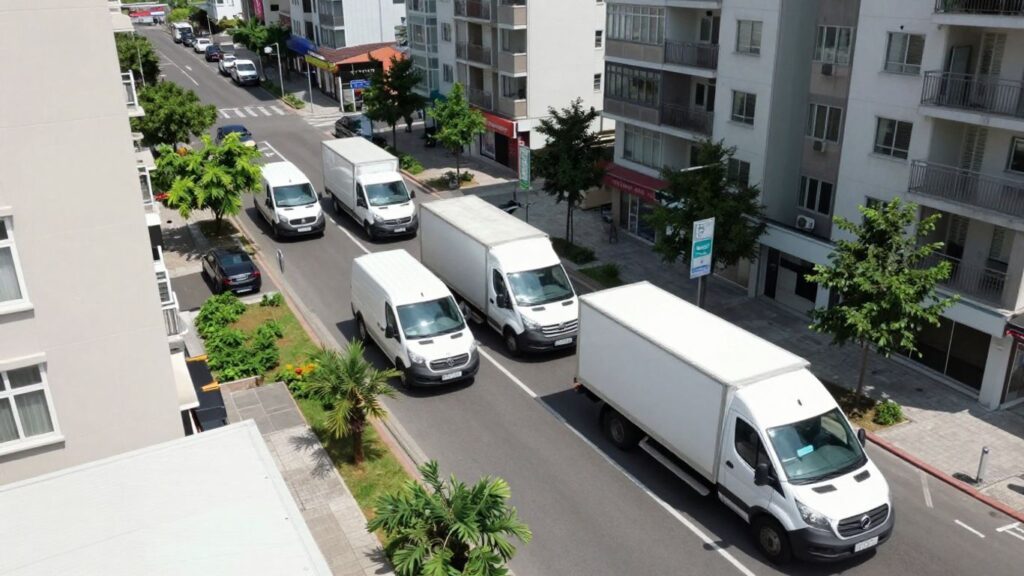
Understanding fleet routing optimization
Fleet routing optimization is the process of shaping a delivery plan around many moving parts at once. We consider the number and location of stops, promised delivery times, available vehicles, driver hours, traffic, and loading limits rather than treating each trip as a simple journey from A to B. The aim is a workable plan that uses fleet capacity carefully while protecting service quality.
How route optimization differs from route planning
Route planning usually defines a sequence of stops and a path between them. Optimization goes further by comparing possible sequences against operational constraints and selected priorities, such as travel time, mileage, cost, or on-time performance. We can therefore use planning to create a route and optimization to decide whether that route is the best practical fit.
The role of delivery windows, stops, and vehicle constraints
A delivery window can change the order in which stops should be visited, even when another sequence covers fewer kilometres. We also need to account for stop duration, vehicle capacity, access restrictions, refrigeration, lifting equipment, and the hours a driver can work. These details turn a map into an operational model.
Why manual routing becomes difficult at scale
Manual routing may work for a small number of familiar deliveries, particularly when one dispatcher knows every street and customer preference. As the fleet grows, however, each added stop creates more possible combinations, and a late order or absent driver can force several routes to be reconsidered. Spreadsheets and memory also make it harder to see how one change affects the whole day.
How optimization affects cost, service, and productivity
A better route can reduce unnecessary distance, idle time, and duplicated travel while helping drivers complete more realistic workloads. It can also make customer promises easier to keep because delivery windows are considered before vehicles leave the depot. The practical gain is better coordination, not simply a shorter line on a map.
Gathering the data needed for better routes
The quality of a routing result depends heavily on the quality of the information we provide. Addresses, service times, vehicle details, driver availability, and traffic assumptions all influence the proposed sequence. Before adjusting an algorithm or buying software, we should establish whether the underlying operational data reflects what happens on the road.
Mapping vehicles, drivers, customers, and service areas
We begin by creating a current view of the fleet, the drivers who operate it, the customers who receive service, and the areas each depot covers. A customer record may need an accurate entrance, loading point, contact detail, and preferred arrival period rather than just a street address. Driver schedules and depot locations belong in the same picture.
Using traffic, distance, and travel-time data
Distance alone rarely predicts an urban delivery day. We need travel-time estimates that reflect road layout, congestion patterns, one-way streets, loading conditions, and the time of day. Historical travel information can support planning, while current road conditions help us judge whether a route needs attention after dispatch.
Accounting for vehicle capacity and equipment requirements
A route is not useful if the assigned vehicle cannot carry its load or reach the required sites. We should record weight and volume limits, vehicle dimensions, temperature needs, tail lifts, ramps, and other equipment that affects service. This prevents a mathematically efficient plan from failing at the kerb.
Improving data quality before optimization begins
Data preparation is often the least visible part of a routing project, but it prevents avoidable rework. We can review records for duplicate customers, missing unit numbers, unrealistic service times, closed locations, and outdated vehicle details. A simple validation routine gives the routing process a more reliable starting point and makes later performance comparisons fairer.
Choosing the right routing strategy
There is no single best routing strategy for every fleet. A regular wholesale run may suit a repeatable plan, while same-day urban deliveries may need frequent adjustment. We should choose an approach based on demand patterns, customer commitments, operating hours, and how much uncertainty the team faces during the day.
Static routes versus dynamic route optimization
Static routes are prepared in advance and can work well when stops and schedules change very little. Dynamic optimization is more suitable when new orders, cancellations, traffic incidents, or vehicle issues regularly alter the operating picture. Many fleets use a planned base while keeping enough flexibility to revise selected routes when conditions shift.
Balancing the shortest route with the fastest route
The shortest route is not always the fastest, and the fastest route is not always the cheapest. We may need to weigh distance against congestion, tolls, turning restrictions, waiting time, and the likelihood of a missed delivery window. A clear objective helps dispatchers understand why the proposed route favours one measure over another.
Prioritizing delivery windows and customer commitments
Customer commitments should be translated into specific routing rules rather than informal notes. We can mark hard windows that cannot be missed, softer preferences that allow some movement, and stops that require a call before arrival. This gives the routing process a hierarchy and helps us make sensible trade-offs when every request cannot be treated as equally urgent.
Handling pickups, returns, and mixed service types
A route may include deliveries, collections, returns, exchanges, installations, or failed-delivery revisits. Each type can have a different duration, equipment requirement, and loading consequence. We should model these activities as distinct stops so the plan reflects what drivers actually do, not just where they travel.
Using technology to optimize fleet routes
Technology can bring routing inputs together, compare alternatives, and make changes easier to communicate. It does not remove the need for operational judgement: dispatchers still need to check unusual sites, customer sensitivities, and local knowledge. The most useful system supports decisions without hiding the assumptions behind them.
How fleet management software supports routing decisions
Fleet management software can help teams organise vehicle information, monitor activity, and review route performance in one working environment. We can use it to compare planned work with what drivers complete and to identify recurring delays or underused capacity. The value comes from connecting those observations to the next planning cycle.
Connecting GPS, telematics, and order management systems
GPS can provide vehicle locations, while telematics may add information about movement and vehicle use. Order management data supplies the stops, service requirements, and customer commitments that routing needs. Connecting these sources reduces repeated entry and gives dispatchers a clearer view of the gap between the order book and the road.
Applying AI and automation to changing conditions
Automation can help process many constraints more quickly than a person working manually, particularly when routes need to be recalculated. AI-assisted tools may identify patterns in travel times or suggest responses to new conditions, but we should still test the result against local operating knowledge. Automated decisions are only as dependable as their inputs and rules.
Deciding between standalone software and integrated platforms
A standalone routing tool may be easier to introduce when the immediate need is route creation. An integrated platform may be preferable when routing must share information with orders, vehicles, driver communications, or reporting. We should compare data access, implementation effort, user training, support, and the risk of creating another disconnected system.
Building an effective fleet routing workflow
Good routing is a repeatable operating process rather than a single calculation made at the start of the morning. We prepare clean orders, apply constraints, review the result, and keep a channel open for changes. That rhythm helps the plan remain useful when the day differs from the forecast.
Preparing orders and constraints before dispatch
Before generating routes, we should confirm that orders are complete, addresses are usable, and service requirements are recorded consistently. We also check vehicle availability, driver hours, depot cut-off times, loading sequences, and priority commitments. Early preparation is less disruptive than discovering a missing constraint after a vehicle has departed.
Assigning stops to vehicles and drivers
Stop assignment should reflect more than geographic proximity. We consider capacity, equipment, driver qualifications, territory familiarity, working hours, and the order in which goods are loaded. A balanced allocation can be more valuable than filling one vehicle to its theoretical maximum while leaving another with an impractical schedule.
Reviewing optimized routes before releasing them
A dispatcher should review the proposed plan before it reaches the field. We look for implausible arrival times, awkward access points, excessive stop density, loading conflicts, and routes that depend on assumptions we know are unreliable. This short human check catches exceptions that a general model may not understand.
Communicating route updates to drivers in the field
Drivers need clear information about their stop sequence, special instructions, changes, and the reason for any significant rerouting. Updates should reach them in a format that fits their workflow and does not create unnecessary distraction while driving. We also need a process for drivers to report access problems, delays, failed deliveries, or new constraints.
Measuring fleet routing performance
Measurement tells us whether a routing change improved the operation or merely shifted the problem elsewhere. We should combine cost, productivity, reliability, and customer measures rather than relying on one attractive number. A baseline from the period before implementation makes later comparisons more meaningful.
Tracking fuel use, mileage, and driver hours
Mileage, fuel consumption, paid hours, overtime, and idle time can reveal whether routes are using resources efficiently. We should review these measures by route type, depot, vehicle class, and delivery pattern where practical. A fall in kilometres is not a success if it comes with excessive waiting or longer driver shifts.
Measuring on-time delivery and customer service levels
On-time performance shows whether routing supports the commitments customers actually care about. We can also track failed deliveries, missed windows, reattempts, complaints, and time spent waiting at sites. These measures put operational efficiency beside the service experience rather than treating them as separate concerns.
Comparing planned routes with actual performance
The planned route is a hypothesis about how the day will unfold. Comparing it with actual arrival times, stop durations, deviations, and completed work shows where our assumptions need adjustment. Repeated differences may indicate poor travel-time estimates, inaccurate service durations, unsuitable assignments, or a need for better driver feedback.
Calculating return on investment from optimization
A return calculation should include the costs of software, integration, training, administration, and process change. Against those costs, we can assess measurable movement in mileage, fuel, overtime, vehicle utilisation, successful first attempts, and customer service. We should separate one-off implementation effects from benefits that continue after the new workflow becomes routine.
Overcoming common implementation challenges
Routing projects often encounter practical obstacles before the algorithm becomes the main issue. People may distrust a new sequence, data may be incomplete, and real roads may behave differently from forecasts. We improve adoption by treating these issues as part of the operating design rather than as evidence that optimization cannot work.
Managing inaccurate addresses and incomplete customer data
An incorrect entrance or missing unit number can add more delay than a small routing error. We should give drivers and customer service teams a simple way to report corrections, then feed verified changes back into the central record. Regular data ownership matters because address quality declines when no one is responsible for maintaining it.
Balancing driver preferences with operational requirements
Driver experience contains valuable local knowledge, including loading difficulties, unsafe turns, and realistic service times. At the same time, preferences cannot override every capacity, safety, or customer constraint. We can invite structured feedback, test recurring concerns, and distinguish a genuine operational rule from a familiar habit.
Adapting routes to traffic, weather, and last-minute changes
Unexpected conditions are normal in urban freight, so the workflow should include clear triggers for intervention. We may need to resequence stops, reassign work, contact customers, or hold a vehicle temporarily when a road closure or severe weather changes the plan. A measured response is better than repeatedly rebuilding every route for minor uncertainty.
Scaling optimization as fleet and delivery volume grow
As volume increases, informal workarounds become harder to control and the cost of inconsistent decisions rises. We should standardise data definitions, approval steps, exception handling, and performance reviews before growth makes them urgent. Scaling also requires training dispatchers and drivers so the process remains understandable, not just technically capable.
Conclusion
Fleet routing optimization works best when we treat it as a connected operating discipline rather than a map exercise. Clean data, realistic constraints, human review, clear driver communication, and consistent measurement give route decisions a practical foundation. When we improve those parts together, the fleet can use its time and capacity more carefully while giving customers a more dependable service.
Frequently Asked Questions
What is fleet routing optimization?
Fleet routing optimization is the process of creating and adjusting vehicle routes around stops, delivery windows, vehicle limits, driver availability, travel times, and business priorities. It aims to produce practical routes rather than simply the shortest possible path.
How is route optimization different from route planning?
Route planning sets out a route and stop sequence. Route optimization compares possible plans against constraints and objectives such as travel time, mileage, capacity, service windows, and driver hours.
What data is needed for route optimization?
Useful data includes accurate customer addresses, stop durations, delivery windows, order details, vehicle capacity, equipment requirements, driver availability, depot locations, and realistic travel-time information.
Can route optimization handle last-minute orders?
It can, provided the workflow allows routes to be recalculated and the new order has complete information. Dispatchers should still review the revised plan for feasibility and communicate changes clearly to affected drivers and customers.
Should the shortest route always be chosen?
No. A slightly longer route may be faster, more reliable, safer for the vehicle, or better suited to a delivery window. The preferred route depends on the fleet’s priorities and operating constraints.
How do we measure whether optimization is working?
We can compare baseline and post-change results for mileage, fuel, driver hours, overtime, on-time delivery, failed attempts, customer complaints, and vehicle utilisation. Planned-versus-actual route data adds context to those measures.
What is the biggest barrier to implementing route optimization?
Common barriers include inaccurate data, unclear ownership, resistance to changed routines, weak system connections, and unrealistic expectations. Starting with a defined operating process and a manageable pilot can make the transition easier to control.